

Lia Smith’s close friends and family all agree: Anti-trans attitudes in the public along with policies by the Trump administration targeting the trans community were the primary known sources of stress and anxiety that troubled the Middlebury senior’s life before she died of suicide in October of last year. This much will be clear to anyone who reads the entirety of an over 2700 word reported story on Smith’s suicide by Juliet Macur.
Those who stop reading earlier, might have a different take away. In one early paragraph, Macur writes that Lia “struggled to feel comfortable in her body and in the world.”
Macur’s summarization continues in the next paragraph.
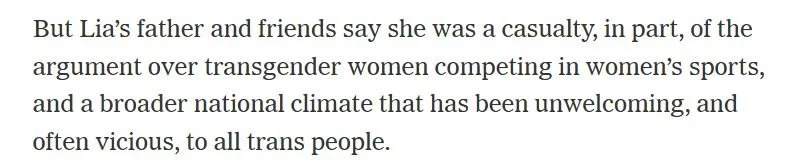
That’s not what Macur’s reporting shows, and it’s not what Lia or any of her friends and family said. There is no quoted source who references any kind of argument over transgender women competing in women’s sports.
The language of an argument is entirely Macur’s, and as such it presents a jarring contrast with what her reporting actually found. As previously reported elsewhere, Macur found Smith to have been the target of a vicious online harassment campaign, one based entirely on a false claim.
Lia’s photo and birth name were posted to Twitter alongside the false accusation that she was competing on the women’s diving team. In fact, Macur reports, Lia only ever competed with the team during her freshman year, when she finished fifth in a Division III finals event.
The online harassment campaign claiming otherwise, which Macur describes as “online criticisms” became “so brutal that Middlebury removed Lia’s bio from its athletics website.”
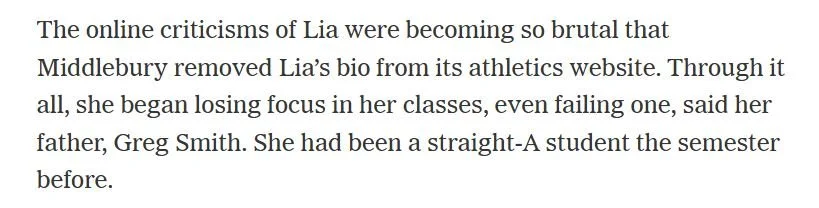
What Macur is describing is neither argument nor criticism. It is a harassment campaign against a young woman based on a false allegation, one fueled by a hatred of trans women so extreme even after her death wasn’t enough to satisfy it, with multiple posts on Twitter (now styled as X) accusing her of perversion while misgendering and deadnaming her.* It is a campaign the Times has done more to fuel than any mainstream news organization in the US, and which it continues to fuel here, in passages that describe Lia’s ability to participate in practices with her friends on the diving team as a debate, with the bad-faith lies of those who harassed Lia glossed over with phrases suggesting perhaps Lia herself was partially to blame.
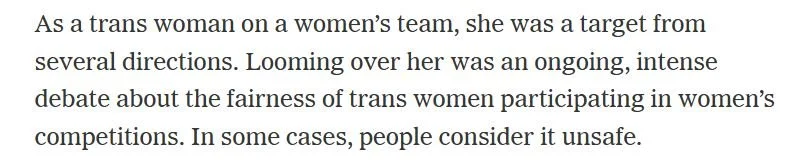
Before her death, Lia spoke publicly about the toll this hatred was taking on her. “It’s really hard putting on the suit every day if you are obviously an outlier,” Lia told the Addison County Independent, as quoted by Macur. “It’s also really hard going in a locker room where you’re not welcome.”
To be clear, the parts of the Times story that confine themselves to Lia herself do an admirable job at describing a well-liked trans student, troubled by harassment and an increasingly eliminationist far right government, whose life ended too soon. This should perhaps not be taken for granted in a paper willing to describe the hate campaign targeting her as “criticism.” (A paragraph in the bottom quarter of the piece does finally use the word “harassment,” and reveals that Lia had been targeted by people yelling slurs at her in person, on campus, not just online.)
The bottom half of the piece also includes some basic facts relating to the so-called argument over trans rights—facts of a sort Times readers have largely been protected from seeing in print. It quotes Lia once telling her father, correctly, that “there are fewer than 10 transgender athletes at the college level, with most of them at Division III.”
It also slips in the fact that the gender specialists Lia saw as a teenager advised her family to go slow, that this had permanent negative effects on her ability to pass, and that she bitterly regretted not having transitioned earlier than just prior to the start of her senior year of high school.
None of this will surprise anyone who closely follows the “arguments” over transgender rights, but for Times readers it may be their first time encountering such facts. Coverage in the paper has long sought to obscure all inconvenient truths, replacing them with the narrative of an argument between trans activists and concerned citizens, a framing echoed in this story. (Of course, placement of these truths in the back half of the piece means fewer than half of readers will get that far.)
Still, the participation of the Times in fueling the fear, lies, and disgust that led to Lia’s death is the sort of inconvenient fact that cannot appear in a Times story in any form, and that omission that lends a ghoulish pall over this piece. Lia should still be alive today, finishing college and looking forward to a future where her transness is no great barrier to happiness and health. While there’s plenty of blame to go around for why that didn’t come to pass, the Times itself makes the short list alongside the harassment mob and Donald Trump. Without the Times’ campaign of bias and division, without its willingness to ignore basic journalistic principles and twist trans stories around an agenda set by the top brass, the mainstream apathy towards threats to trans people’s lives and freedoms would never have come to pass. Without that apathy, the anti-trans agenda could never have advanced this far. And without that, perhaps, Lia Smith would be alive today.
*UPDATE: An earlier version of this story included a link to a hateful post on Twitter made after Smith’s death that included her previous name. On consideration, Assigned decided to describe the tone of anti-trans posts made after Smith’s death rather than linking to one.
Evan Urquhart is the founder of Assigned Media.





Thank you for covering this. I was incredibly disgusted by this piece. Not only did they use it to promote more anti-trans rhetoric, they obviously only run these occasional mildly sympathetic stories to head off criticism for their campaign of terror against trans people. This "suicide" was really a social murder, and blood is on the NYT’s hands, no matter how much they wring them.
Btw, Evan, one criticism. I know it’s important to highlight the hatred, but I really don’t think you should link to someone on Xitter revealing her deadname and such. Take a screenshot, censor it, and link to that.
I think this is a good criticism. I don’t want to add another screenshot, but maybe linking at all isn’t necessary.
Great work. Just wanted to make one point as I’m not sure about your choice here.
The word for the government’s behavior should be "genocidal," not "eliminationist." Genocide by definition includes creating conditions intended to destroy a group of people. That destruction can take all kinds of forms – pressuring people not to transition, denying them medical support necessary to do so, pushing them out of public life, forcing them to move, and committing suicide as Lia tragically did.
The UN’s current definition of genocide does not cover those being targeted based on gender, but that doesn’t mean the word doesn’t apply. It just means the UN didn’t include gender when it wrote up the definition almost 80 years ago. I believe someday it will include gender among other attributes it failed to name.
Refusing to call attacks on trans people "genocidal" puts trans people in a category separate from other groups facing the same threat. It withholds from the conversation the teeth of that word. Why?
I appreciate your responding to the NYTimes story. Their coverage of trans issues is dismal to harmful, and the comments on such stories are some of the most abhorrent I’ve seen outside of social media. I’m glad to see they disabled comments on this story. That’s one win, at least.