

In a post presented as a vindication, information provided to the gender critical substack writer Jesse Singal cast further doubt on the veracity of the allegations of Jamie Reed. Readers will remember that Reed once worked with transgender youth in St. Louis, and has made wild, unverified claims about her former employer which have been disputed by more than 20 parents who sought treatment for their children at the same center where Reed once worked.
At the heart of the matter are a couple of claims Reed made about patients at the Transgender Center, one concerning a single patient, another about a larger group of youth who were seen. In her affadavit, Reed claimed, “children come into the clinic using pronouns of inanimate objects like “mushroom,” “rock,” or “helicopter.” She also provided an example of a “patient [who] came to the Center identifying as a “communist, attack helicopter, human, female, maybe non binary.” Reed further describes this patient as being in very poor mental health.
Singal attempts to corroborate these claims in two ways. First by establishing that there was a chart for a patient at the Transgender Center which included the words “communist, attack helicopter, human, female, maybe non binary” and second by asking a fellow gender critical writer, Hannah Barnes, and a gender critical psychologist, Erica Anderson, if they know of similar cases of children who identified as inanimate objects. Singal’s post establishes that neither Barnes nor Anderson has ever encountered children identifying as inanimate objects, and that Jamie Reed knew that the teenager whose chart she has shared with the public was making a joke.
Singal manages to present this all as vindication of Reed, but we can dispense with the verbal gymnastics required to do that and look at what Reed, Barnes, and Anderson actually said. First let’s take Reed. In his very first paragraph setting up his conversation with Reed, Singal seems to acknowledge that she says things that don’t entirely add up. She claims not to be very online, but immediately recognizes the specific internet fracas between big twitter personalities Singal is asking about.
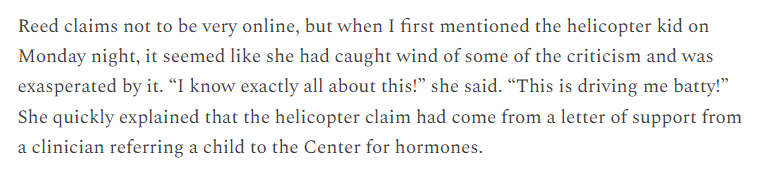
We’ve included this mostly because it’s pretty funny. The woman claims not to be very online, totally gives herself away as being extremely online indeed, and Singal himself can’t conceal his doubts that she’s telling the truth.
More subtantively, Reed describes noticing a nonbinary teen who was having a difficult time, and pulling up their chart. In the letter from an outside therapist who had referred them for hormone therapy the phrase attack helicoper appeared. Reed, who had no medical training and whose position in intake and scheduling did not include diagnosing or recommending treatments for patients, considered this passage a red flag.
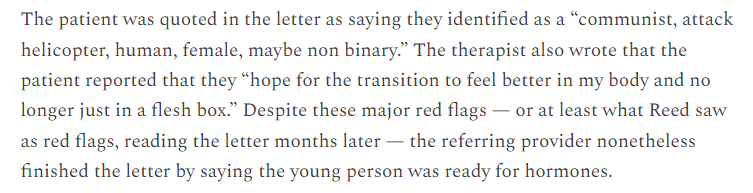
Reed provides no other information from the therapist’s letter, how long the patient attended therapy before being seen at the Transgender Center, or what happened in their assessment. But we do know that “I identify as an attack helicopter” is a widely known internet joke (also known as a meme), that the point of the joke is to mock trans people, and that, even if she was not very online, Jamie Reed admits she knew it was a reference to a joke at least as early as December of last year.
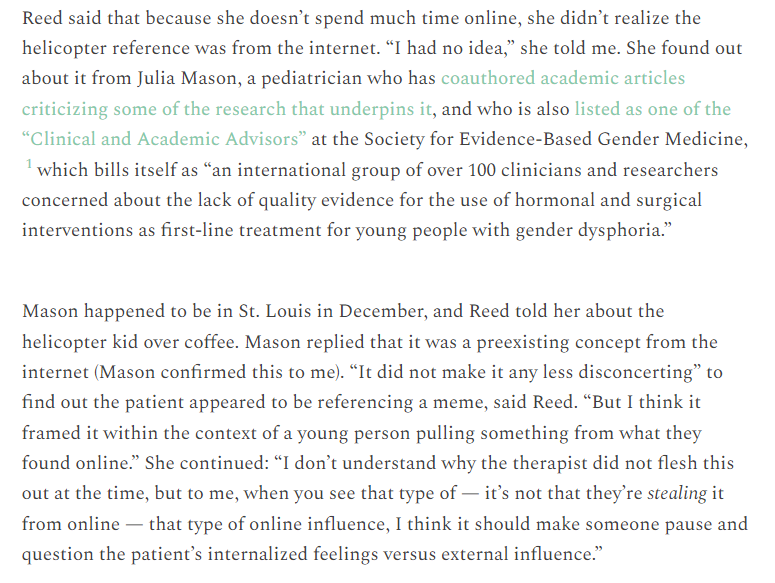
This does not support Reed’s claim that patients came to the Transgender Center identifying as inanimate objects. To the contrary, it contradicts that claim. It suggests that Reed is presenting a version of what happened at the center that she knows is false, taking cherry-picked words from case files out of context to make it seem as though a severely delusional youth, who didn’t know if they were a human being or an object, was given cross sex hormones with no assessment or attempt to find them alternative treatment. When the story is presented in more detail, we find that a teenager made a reference to an extremely well known joke, and Reed knew this.
The other way Singal attempts to vindicate Reed is by asking Hannah Barnes and Erica Anderson, both gender critical people who have had personal experience with transgender youth, if either of them know of children who identified as inanimate objects. Both Barnes and Anderson say they do not. Here’s what Singal says about Barnes’s response:
After we were done recording, I mentioned the most controversial parts of Reed’s affidavit and asked Barnes if she found the document surprising. She answered that while she had not personally encountered examples of young people identifying as inanimate objects in her reporting, and did find that extreme, she generally did not find the document surprising.
And, here’s Anderson:
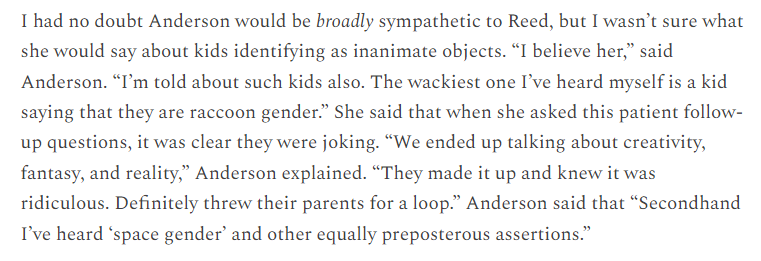
Both Barnes and Anderson are sympathetic to Reed, and believe she is telling the truth. But neither one has ever met even one child who identified as an inanimate object. Remember, Reed’s affadavit referenced multiple children “using pronouns of inanimate objects like ‘mushroom,’ ‘rock,’ or ‘helicopter,’” and her best evidence is one child who did not use such pronouns or identify in such a way, but made a reference to a meme. The closest Anderson can come is a story of a child who joked about gender with her, much like the teen Reed referenced seems to have joked with their own therapst about being a helicopter.
Singal has succeeded in demonstrating that transgender teens make jokes about gender and reference memes, and that gender critical staff and providers may use these jokes as a reason to deny treatment.
What’s being lost is the humanity of these teens, who are making jokes and opening up to these providers because they trust them to have their best interests at heart. To take an innocent joke made by a teenager, and attempt to spin it into evidence that the child has such severe psychosis they don’t even understand they are a human is an act of breathtaking cruelty and dehumanization. That is the picture of the real Jamie Reed that emerges, even in such a sympathetic outlet as Jesse Singal’s substack.





This is uncritical. That a supposed joke demonstrates some previously unacknowledged "humanity" of a patient "opening up" that is being manipulated unduly by Reed is a willful framing. Having only the benefit of reading a letter by a therapist, the context of that therapists conversation with the patient and whether or not it was a joke could only be known by the therapist who composed that letter, depending on the details included. It is not for Reed to interpret the context nor would it be appropriate in an affidavit for her to make speculation on the meaning of things that cannot be verified, regardless of whether she spoke to someone in December who proposes a connection between the quotation and the existence of a meme or not. The point of the affidavit is to provide verifiable information and context that is known. The context that is known is included in the affidavit entry, which is that the patients mental health had been worsening since being prescribed hormones and that the patient reported that they couldn’t pin down their gender identity. According to reporting by Singal, these facts are what was presented to Reed by a colleague before she decided to look at the patients history and find the therapist letter in the first place.
It could just as easily be inferred from the therapist letter that making jokes in such a way could indicate that the patient is not taking sessions with their therapist seriously enough to reassure a clinician that they are in a state of mind to make informed consent, or that they are mature enough to make informed consent. That the endocrinologist might not have read the whole letter, or that balls were being dropped across the communication chain seems to be the concern. Given the context provided about reports on the patients mental health and ability to articulate their identity, I don’t see how any reading of the situation would not warrant concern.
This is critical rather than uncritical. Merely accepting Reed’s claim is uncritical. Reed’s ethical lapses are immense. Having been on the other side of a professional who took it upon herself to call my wife to tell her that I am gay without my knowledge or permission, I know how harmful it is for someone to make use of information that is not theirs to use. The point of the affidavit might have been to provide verifiable information and context that is known, but it doesn’t do that. It uses the claim of a nonprofessional reading a clinical assessment without really understanding it. I’ve known several trans men and women. All of them would have benefitted greatly from early intervention in my opinion, but none of them received more than familial rejection and religious interventions. Ignorance led to harm for them.