

A freelance journalist’s call for sources became fodder for renewed concern about the New York Times’ priorities in covering transgender issues. Benjamin Ryan, who is best known for his coverage of HIV and AIDS, says he sent emails with a variety of wordings to at least 200 contacts as part of his research for an article on how pediatricians and other non-specialists respond when they encounter youth with gender dysphoria, and how those first line providers understand the treatment and referral options. (According to Ryan the NYT had already decided not to go ahead with the story earlier in the week, but he still hopes to place the story elsewhere.)
Alejandra Caraballo, a trans woman and journalist, shared a leaked copy of the email Ryan sent out to Twitter on Friday, April 14. The tweet raised concerns about the planned piece because it expressed a desire to speak with “physicians who might have misgivings about the gender-affirming care treatment model, or who otherwise have theories about why we have seen such a recent surge in trans-identifying young people.”
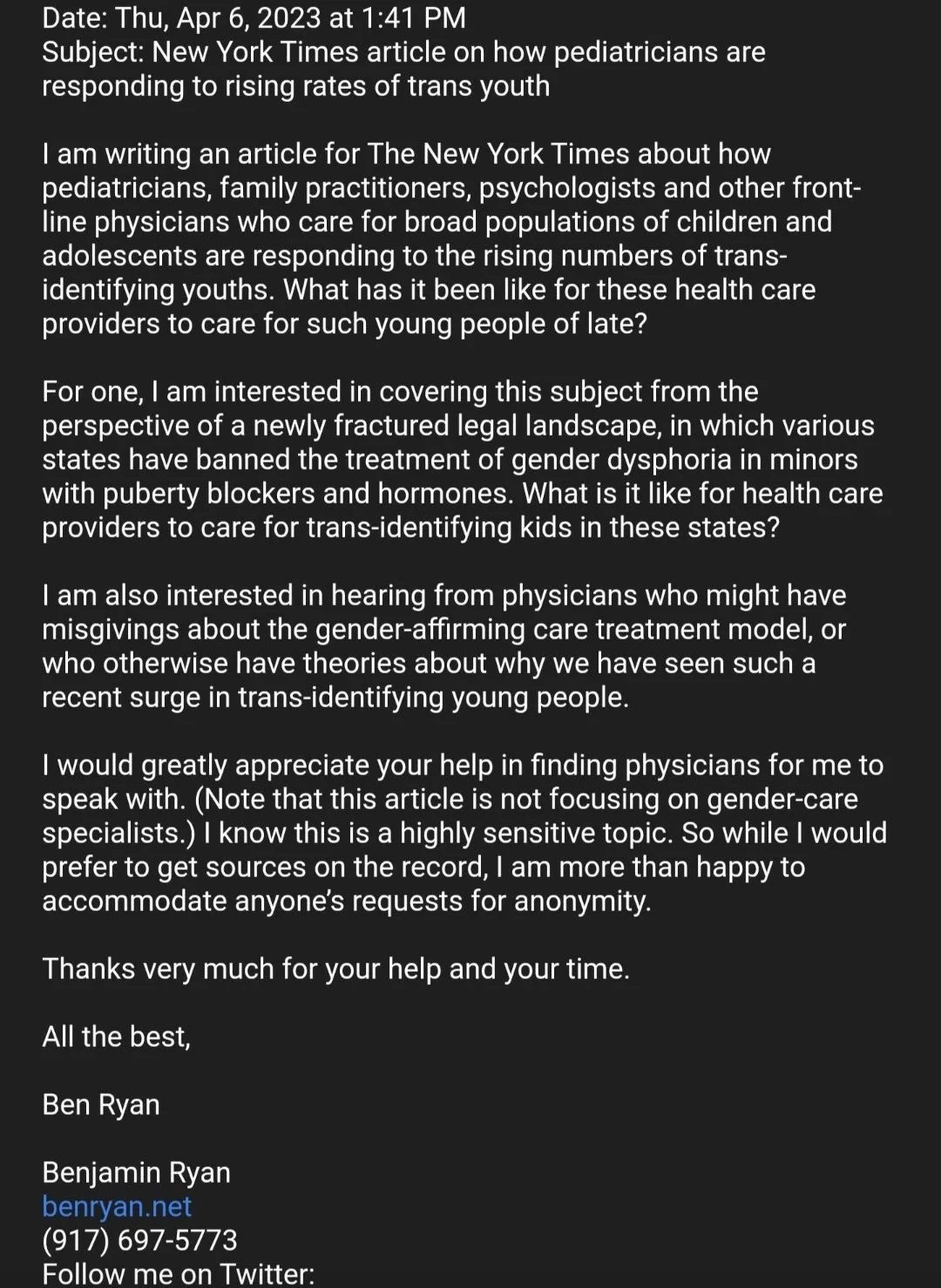
“It was not just me who was concerned,” said Caraballo. “This was on a listserv and people were warning each other not to respond to it. It was raising red flags for a lot of people.”
In addition to highlighting the fact that Ryan was soliciting theories and criticisms of gender-affirming care specifically from non-experts with misgivings, Caraballo pointed to Ryan’s use of the phrase “trans-identifying.” The phrase is most commonly used by anti-trans activists wishing to cast doubt on the legitimacy of trans people and their identities, implying that these identities are temporary or fraudulent. In particular “Trans Identified Male” or “TIM” has often been used as a slur to denigrate and misgender trans women, usually by the most extreme, committed anti-trans actors.
Another aspect to the concern was the association with Ryan’s call for sources with the NYT, a newspaper which has been widely criticized as showing bias in its reporting on stories about gender-affirming care for youth, specifically. These criticisms have been so widespread they even resulted in an open letter from a huge number of the Times’ own contributors, which has reportedly resulted in retaliation in the form of written warnings from the paper to staffers who signed the letter. (All of Assigned’s past coverage of the paper of record can be found here.)
Ryan believes the concerns about his intentions in writing this story are unfounded. He explained the intention behind a reported story focusing on medical providers who aren’t experts, saying, “A lot of the coverage is focused on gender clinics in particular, but a pediatrician or family doctor or, sometimes, a psychologist is the first contact a young person has with a health care provider.”
“There are many children suffering greatly, both with gender dysphoria and with mental health care generally,” he continued. “We can get lost in these debates, but this is about trying to help kids. We should be advocating for the best care possible for all children.”
Asked to comment on the criticisms he’d faced online, Ryan described a wide-ranging research process focused on speaking with as many people as possible to better inform himself about the issues in gender-affirming care, which he has not covered previously. “I want to hear as many perspectives on this as possible. I say I’m looking for people with misgivings, and that’s part of it, but I’m also looking for people who are more supportive.”
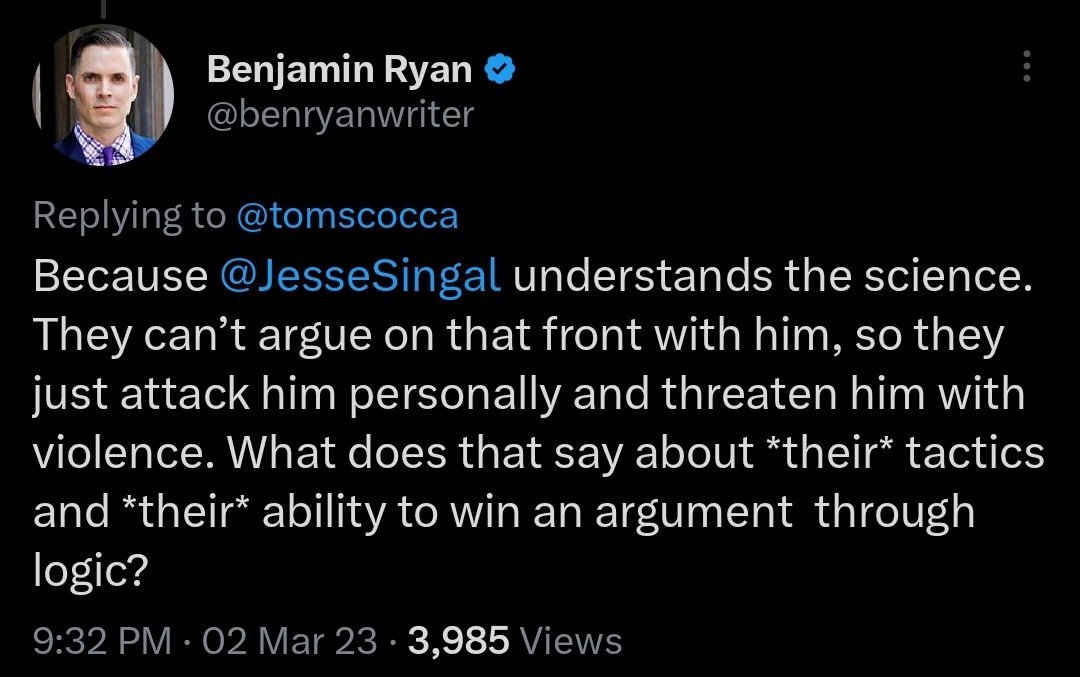
Part of the reason a prospective story from Ryan in particular raised so many concerns may have had to do with some of the reporter’s prior public comments. For example, in March he tweeted praise of Jesse Singal’s understanding of the science on this issue. Singal is a controversial figure in the field, in part due to his legendary feuds with trans rights activists on social media, but also due to the consistent pattern of one-sidedness to his reporting on the topic. This one-sidedness has even, on occasion, led to Singal misinterpret the import of his own reporting.
Ryan, however, is not Singal. He points out that he been attacked by the right for being insufficiently transphobic as recently as late March, when a tweet of his referenced anti-trans sentiments in Nashville soon after a shooting in that city where the perpetrator is believed to have been transgender. “I get attacked viciously by the left and the right because I don’t share my positions on things,” he said. “There’s a constant misinformation stream for everything I say or do, and they can almost never point to words I published that support whatever their thesis is about my motivations.”
Of course, it’s impossible to know what the piece itself will look like before it’s published. While concerns raised about both the NYT and Ryan’s past comments make the nervousness around the proposed story understandable, here’s hoping Ryan’s work itself dispels all doubts and makes a valuable contribution to a topic which has been riddled with misinformation and moral panic.






Evan, thank you so much for this article! Honestly, I’m kinda scared that because Ryan claims to be a political moderate in his quote, his work could gain traction in a way that a staunch conservative’s piece wouldn’t.
This is just my speculation, but he may be like a more conservative Biden. (For context, Biden rode the 2020 election on BLM and then ended up expanding police budgets.) Ryan may do the same in his piece and pander to a moderate liberal audience and convince them to vote against gender-affirming care for minors. His claim that he’s "attacked viciously by the left and the right" could help with that.
I’m sorry if that’s already implied in the piece, btw! I just wanted to add my way-too-many-cents to your article. :))
Hello. I was one of the pediatricians that he interviewed for this. I had a sense going in what his angle was so I stuck to AAP guidelines.