
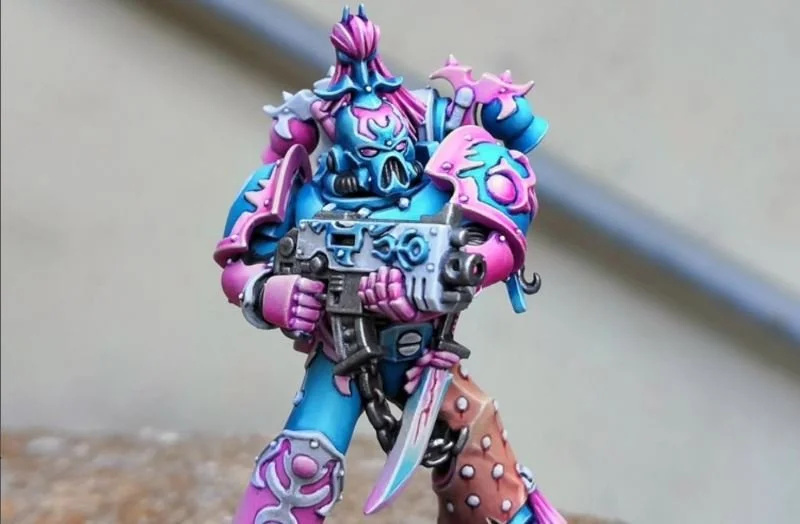
Warhammer 40,000 is the world’s most popular tabletop wargame. In the popular imagination it’s a hyper-masculine affair with power armor, evil aliens, and demons roaming outer space. However, one lesser known corner of the fandom is distinctly queer. French miniature painter CerberusXt exemplifies queer Warhammer with space marine models based on the colors of Pride flags. Trans space marines with bold pink armor are a mascot and a meme for queer wargaming fans.
How could something so masc-coded attract such a large trans following? Despite the macho gloss, this is a hobby centered around role-playing, imagination, and self expression. Perhaps it’s natural for gender norms to become subject to customization as well.
A tabletop wargame is a game between two or more people which simulates a battle of some type. They’re played with miniatures, dice, a table, and sometimes terrain, measuring tools or other equipment. It is generally competitive to some degree with gameplay centered around strategic decisions, but also around storytelling.
Wargaming hasn’t quite broken into popular culture the way tabletop RPGs like Dungeons and Dragons has, but if you know of one wargame it’s almost certainly Warhammer, a British wargame and media franchise by Games Workshop known for its darkly satirical lore.
Aasa Timonen, a trans woman and doctoral researcher at Tampere University in Finland, researches Warhammer from an academic perspective, spoke with Assigned Media about the game. Timonen explained that the roots of tabletop wargaming can be traced back to chess and similar games of strategy, but the real nucleus of the current genre can be found in the 19th century, with games intended to train military officers. The first designed truly for leisure emerged in the early 1900s, including one made by HG Wells in 1913 called “Little Wars”.
Games can range from a casual match played alongside beer and pretzels to competitive play modeled after professional sports. The hobby can be expensive, with a standard Warhammer 40,000 army costing about $600, though smaller scale games called “skirmish games” can cut down the price dramatically.
Although most people who play tabletop wargames are cis, a sizable contingent of transgender people who play tabletop wargames, particularly transfemmes. Several high level Warhammer players have been transgender, with analogous achievements in various other wargames.
Assigned spoke with three trans women wargamers about their experiences in the fandom. Dakota, from Virginia, predominantly plays BattleTech. Serena, from New York, plays BattleTech, Infinity, Firestorm Armada, and Starfleet Battles. Vali, from Ohio, plays Marvel Crisis Protocol and Warhammer 40,000.
These gamers described the groups they typically played with as inclusive. Dakota plays with a group of ten that includes three other trans people, Vali mentioned that her wargaming community in Ohio has several other trans women within it, and Aasa Timonen, also a trans woman, mentioned attending explicitly trans inclusive meetups in the United Kingdom.
When Assigned Media inquired about how trans people became associated with wargaming, Timonen shared her personal theories on why. She said that in the 2010s, trans hobbyists became increasingly visible due to the rise of social media, and the increasingly online trans community spread some of their in jokes as memes. Timonen believes the reclamation of machismo and militant imagery can be an act of radical self-expression for many trans wargamers.
During roughly the same time Warhammer 40,000’s storylines became less gendered and were no longer marketed almost exclusively to a male audience. These developments helped new audiences join the fold. Although early wargaming tended to cater to a white male audience wanting to reconstruct historical European stories including gender essentialist biases (something the University of Alberta scholar Dr. PB Berge calls “fantasy realism”, according to Timonen), this became significantly less of a factor as the games became more popular and more accessible to general audiences. “Nowadays, there have been attempts to balance things out, with nonbinary characters appearing in various transmedia products,” Timonen noted. “In this way, Games Workshop is signaling towards trans & nonbinary people that the hobby is welcoming them.”
However, all is not rosy for trans people in wargames. The wargamers Assigned spoke with each described experiences with transphobic harassment in some form. Dakota described having been referred to with slurs from players she’s shared spaces with. Serena mentioned receiving an online death threat from a wargaming space, and Timonen became the target of an online harassment campaign.
Several major tournaments have also been held in areas that are dangerous for trans people to travel to, for instance, the World Championships of Warhammer (commonly known as Warhammer Worlds) are held in Atlanta, Georgia and Gen Con, one of the largest tabletop gaming conventions in the world, is held in Indianapolis, Indiana. Last year, Emma Hallinan, a trans woman who won a major tournament in Australia, referenced transphobia in the US in a public statement explaining why she was boycotting the most recent iteration of Warhammer Worlds.
Despite this, there is still a great degree of enthusiasm for wargaming among trans players. Interviewees were eager to share their favorite gaming moments, with one quipping “Roll boxcars and play Purple Bird”, a reference to BattleTech’s Free Worlds League faction.
For numerous transfemmes, tabletop wargaming is a vital lifeline to social connections, something that is both life-giving and scarce not only for trans people but all people in a digital age. Dakota summed this up nicely, saying “Wargaming itself is not inherently magical. It is the way that everyone who plays it comes together, appreciates each other just for being there, and the communities that grow around the game. If you find one, treasure the people in it. If you can’t, build one, and you won’t regret it.” For trans wargamers, community will always be the biggest draw.
Adi Kung is a journalist, writer and poet. She currently resides in New York.



I’m transfemme yet I have not the slightest interest in gaming of any kind. Here in the UK gaming seems prevalent amongst trans people and that has led to people such as myself feeling excluded from trans social groups because so many of them are intensely focused on gaming: talking about it and doing it. For me, that is a shame, but I don’t want to deny trans gamers their enjoyment, so I stay away.
In the nicest possible way, it’s one thing when the other ‘side’ constantly invisibilises trans men and treats ‘trans people’ as synonymous with ‘trans women’, but it sucks even more when other trans people or ‘allies’ do it. Why not say ‘trans women’ or ‘trans femmes’ if that’s what you mean? Swap "How could something so masc-coded attract such a large trans following?" for "How could something so masc-coded attract such a large following of trans women and trans femmes?" Firstly, masc-coded things often don’t put off trans men/mascs, so you’ve straight-up erased trans men from "trans". Secondly, the anti-trans lobby erase trans men as a route to stealth-remove cis women’s reproductive rights – by joining them in that erasure, instead of challenging it, we allow that. Please do better.
We appreciate the feedback. We did mention a few times that wargaming is a hobby transfemminine people in particular are known for pursuing, but we felt that making the story only about transfemmes would leave out the transmascs in the fandom. While it’s not a transmasculine coded fandom/subculture the way, say, Splatoon is, there are certainly transmascs who play wargames.
I’d also say that asking"How could something so masc-coded attract such a large trans following?" is generally appropriate considering the close political association between masculinity and transphobia.
I’m not sure treating the terms ‘masc-coded’ and ‘masculinity’ as lowkey meaning ‘transphobic’ treats trans men much better – masculinity isn’t necessarily toxic. And you did leave out transmascs. I fully appreciate there are trans men/mascs in the fandom too (that was pretty much my point) – but this particular article is almost solely about trans women and trans femmes. That’s fine – there’s nothing wrong with an article about how surprising and subversive it is that something so masc-coded could attract such a large transfemme following – great article! – but as I said, it would NOT be a particular surprise for trans men & transmascs to enjoy masc-coded things. So, if the surprise is that feminine people enjoy masc-coded games, then treating trans men as having the same feminine leanings as trans women isn’t okay. Alternatively, if, as you say in your reply, you merely meant ‘transphobic’ or ‘toxic’ by ‘masculine’ or ‘masc-coded’, firstly please say that instead; but secondly, I’d urge you not to equate ‘masculine’ with ‘transphobic’ then expect trans men to feel like we’ve been included or seen, or like our masculinity has been viewed as healthy.