

In the Atlantic today an article on transgender women’s participation in sports by Doriane Coleman opens by claiming that all women athletes have depended on sex-segregation to elevate their inferior-grade of athletic achievement. This ahistorical supposition, stated as if no one could find anything to object to in it, lays bare the misogyny at the heart of every trans-exclusionary argument.
Coleman’s piece is primarily concerned with a proposed regulation by the Biden administration that would allow schools to limit the partcipation of transgender athletes if they could show that such restrictions were backed by evidence and had a legitimate purpose. (She claims to support Biden’s regulation, but toward the end this is complicated by her objection to Biden allowing schools not to discriminate if they don’t want to. Her real view seems to be that trans athletes should be restricted by law from competitive sports past puberty, with no exceptions.)
If Coleman is doing this for the sake of women, what’s her view on exceptional women athletes? In the first paragraph, she says we would never even know their names if athletic programs weren’t sex-segregated.
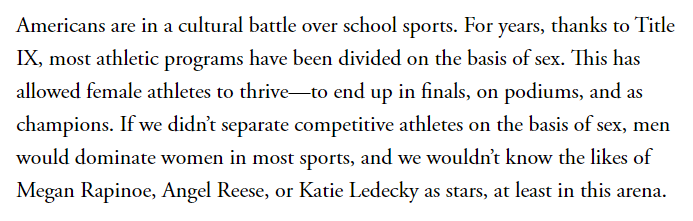
This is a bold claim. Coleman believes that every woman who has become a star athlete would be nothing if men and women in sports were treated equally. It’s a widely held belief among transphobes, who view women’s inferiority as a biological weakness that can never be overcome, only made allowances for. Rather than seeing women as inherently equal to men and held back by generation upon generation of sexism and exploitation, this view of women places them permanently below men due to biology, necessitating special protections from the natural dominance and danger men embody. Women in this worldview are hothouse flowers, beautiful but vulnerable.
Coleman credits a decision in 1975 for the accomplishments of women in athletics, which she repeatedly stresses are not as good as the accomplishments of male athletes. In 1975, Title IX of the Education Amendments of 1972 was clarified to ensure that sports would never be de-segregated. According to Coleman, without the decision to tie equal funding for women in sports to sex-segregation resulted woman could never have excelled in athletic competition.
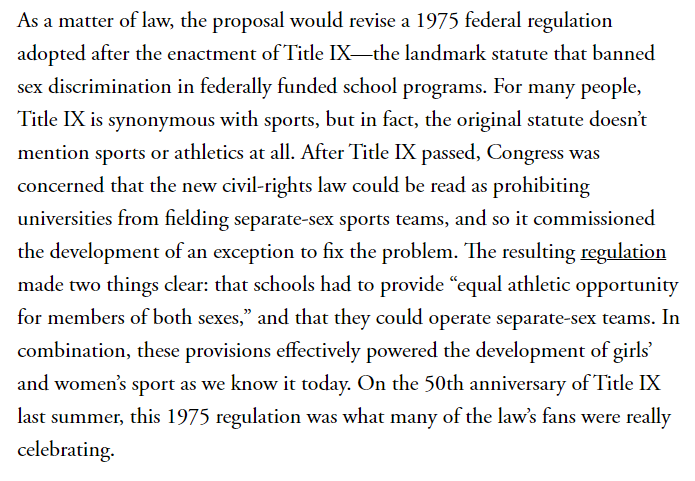
The obvious question, that Coleman nexplicably fails to ask is this: What if, in 1975, schools had been forced to provide “equal athletic opportunity for members of both sexes” and were also banned from operating seperate-sex sports teams?
Of course, to answer that is as impossible as saying Megan Rapinoe and Katie Ledecky wouldn’t have been stars without sex-segregation. And, while differences in funding, respect, and competition almost certainly hold women’s achievements back, this essay is not arguing that testosterone plays no role in the development of muscle or that this has no implications for athletic achievement. However, even in our male-dominated sports environment there are hints that women’s bodies are naturally better at some physical tasks than others. Women have higher pain tolerance, and may have more endurance. Even today there are sports where cis women equal or out-compete cis men such as target shooing, archery, horseback riding, and ultra-endurance competitions. In gymnastics small, muscular, limber bodies have the edge over taller, broader ones. A similar state of affairs obtains in figure skating.
Sports culture as we know it has been shaped by the belief that men’s bodies are superior to women’s, so it can be difficult to place yourself outside that frame and ask whether women’s seemingly lesser accomplishments are a result of male’s natural physical dominance, or of their social dominance which selects sports men have an advantage in and privileges them. By carving out sports as one place where seperate-but-equal would rule the day, the 1975 congress made sure we’d never find out what would happen if this social dominance was questioned. Far from protecting women, congress was protecting the belief in male superiority from the possibility that, if women were ever given full equality, male dominance in athletics might falter.
Coleman wants you to believe that if women had recieved full protection from discrimination in 1975, no woman would ever have been a star athlete. This is a failure of imagination on her part. Sexism is what shaped the desire to prevent women from having full equality in athletics with no restrictions, and it continues to shape the beliefs of people who think female bodies are inherently inferior to male ones just because the sports landscape has selected for male excellence at the expense of women. Trans women in sports threatens the assumption that women benefit from segregation and that, at heart, is why it has become such a hot-button topic.






While there may be an argument that, say, a Diana Tairisi or Megan Rapinoe could find a spot on a male pro basketball or soccer team, you surely cannot be positing that females could make the medal podium in track?
Flo-Jo’s (likely steroid-aided) women’s 100m dash record of 10.49s from 1988 still stands today. No female in 35 years has beaten it.
But a 15-year-old boy has (10.2s), as did four 16-year-olds in 2016. The fastest female Olympian in 2016 did 10.71s; eight high school boys ran faster that year.
Because of the sex segregated nature of athletics, we can’t know for sure what women are capable of in competition. There are issues of monetary support, recruiting, retention, encouragement, coaching, track time, and so forth. If you discount Flo-Jo, the most recent women’s 100m record would be 10.54s. In 1922, it was 13.6. That’s a 3 second improvement. During the same time period, the men’s record went from 10.4s to 9.58s, less than 1 second improvement. Women have improved at a faster rate and have considerably shrunk the "performance gap." Furthermore, structural sport issues prevent the direct comparison of women’s and men’s performance in many sports by having different equipment, rules, judging criteria, or distances. Additionally, by separating men and women in competition, the fastest women are missing out on the chance to compete against men who are faster than them and could provide pacing or a competitive impetus to push themselves faster.
Second, the hyperfocus on the podium misses the larger world of sports. In the 2020 Olympics 100m competition preliminary round and qualifying heats, there were 24 times recorded by runners in the men’s competition that were slower than the 10.61 of the women’s gold medalist and many more that were slower than the 10.2s of that high schooler you mentioned. Why did those runners bother when there was once a 15-year old who ran faster than them or when they wouldn’t even make the women’s podium?
The vast, vast majority of athletes in the world won’t win anything, let alone the Olympics, which is why basing K-12 trans inclusion policies on a very, very tiny minority of elite athletes doesn’t make any sense.
I think this misses the point. For sports where the biological differences between men and women don’t give one sex a clear advantage, the answer to the question of how should trans people compete is obvious.
Coleman’s article was aimed at the sports where cis men do have a clear advantage – for example swimming. Hopefully we can all agree that in these sports, having a male body is objectively superior to a female body. And because of this, the debate around how trans people should compete is not a simple one.
These types of arguments assume that sports are fair to begin with, and that gender is the main source of inequality. Swimming is a great example. What makes a body "male?" Is height part of that? On average, cis men tend to be taller than cis women. Since winning swimmers tend to be tall, by your logic cis female swimmers with heights in the "male range" should be banned because it wouldn’t be fair to average height women. What about body hair, which is a detriment to swimmers, and more prevalent in many men. What if shaving was banned? Would we then have restrictions on male swimmers with body hair coverage that fell into the "female range?"
VM, I love you. Your points speak to my lived experience as a "female" (read: transmasculine {assigned female at birth but isn’t exclusively a woman} dyadic {non-intersex} person without access to gender-affirming care).
I’ve studied Kyokushin karate for ten years (from 7 to 17). Kyokushin karate is a karate style started by Masutatsu Ōyama and is extremely effective in street fighting due to its emphasis on building tolerance to physical pain.
It’s also male-dominated due to societal standards and is a favorite tool of some white supremacist groups in the Midwest United States.
I’m 18 now and have taken a break for about a year, and that’s given me time to reflect as a student and teacher of the style.
Because my dojo did not segregate fights by assumed and assigned sex or age, we got a small taste of what Evan said – we partially "place(d ourselves) outside that frame" of male "superiority" in competitive sports.
In the dojo, we had "generations" of teenage students that came in. First, there was a "generation" of all cis girls and transmasculine people (w/o access to gender-affirming care), then a second, smaller "generation" of the same demographic, and finally a "generation" of all cisgender boys. I was in the first "generation." Because we were first (and my sensei liked free and/or underpaid labor,) I helped teach all generations after me.
In fighting drills, I was one of the people no one – regardless of sex or gender – wanted to go against due to my strength, force, and energy. I wasn’t a fluke either. Almost everyone in my "generation" had the same reputation.
For context, I was 5’1.5" and weighed about 115 pounds. In fact, I was shorter and lighter than most of my teenage peers regardless of sex!
We weren’t free to be in our dojo – not as people who were assumed to be weaker due to our bodies and ESPECIALLY not after our transitions – but we still kicked everyone’s asses. Including the third "generation" of all teenage cis boys. (Most of them were wiry, 5’6" or taller, and weighed anywhere from 130 to 160 pounds.) They respected us as not only teachers, but as stronger fighters they could learn from.
This pattern held true with the cisgender adults too – cis women fighters, depending on their skill levels, were just under, equal to, or surpassed their peers of all sexes. (There were also no gender non-conforming, trans, or openly intersex adults in my dojo.) For a while, we had a string of cis women fighters and teachers who commanded the same respect as my "generation" of teens did.
The ONE exception to this rule was a sexist and transphobic workout-addicted 40-year-old man who was 6’4" and weighed over 300 pounds. However, EVERYONE had a hard time fighting him, regardless of age or sex due to his size.
Anyway, I’m trying to say that except for extreme examples – like the 6’4" 40-year-old – my AFAB peers and I not only held our own but surpassed cisgender boys due to our willpower, physical strength, and skill level. We did this in the most "primitive" and "masculine" of sports – hand to hand combat.
In my opinion, as a Kyokushin shodan (blackbelt), teacher, and student of ten years, sex – mainly testosterone levels – matter less and less in sports as athletes gain skill. Ability and disability, physical size, and skill are far more important sports characteristics than gender and sex will ever be.